How to Verify and Certify Bulk Silver Bullion: A Free Guide for Serious Investors
For high-net-worth individuals and serious precious metals investors, purchasing silver in bulk—whether 1,000-ounce bars, monster boxes of Eagles, or bags of "junk" silver—is a sophisticated move for capital preservation. However, with large-scale acquisition comes significant risk. The prevalence of advanced counterfeits (tungsten-filled bars or silver-plated lead) makes verification an essential pillar of your investment strategy. In this guide, we detail the professional protocols for verifying and certifying bulk silver to ensure maximum liquidity and peace of mind.
Jump to Section
The Fundamentals of Physical Verification
Before moving to expensive laboratory equipment, every serious investor should master the "First Pass" verification. When dealing with bulk lots, such as bags of 90% silver coins or dozens of 10-ounce bars, speed and accuracy are key.
Dimension and Weight Analysis: Silver has a specific density (10.49 g/cm³). Counterfeits using lead or copper will either be the wrong weight or the wrong size. Use a high-precision digital scale and a set of calipers. If a bar is the correct weight but too thick, it is likely a base-metal composite.
The Magnet Test: While not definitive, a neodymium magnet is a quick filter. Silver is diamagnetic; it will not stick to a magnet, but a magnet should slide slowly down a silver bar held at an angle due to eddy currents. If the magnet sticks, the lot is immediately rejected.
High-Tech Non-Destructive Testing (NDT)
Serious bulk investors cannot rely on acid tests, which damage the bullion and reduce its "freshness" or numismatic value. Instead, we utilize Non-Destructive Testing (NDT).
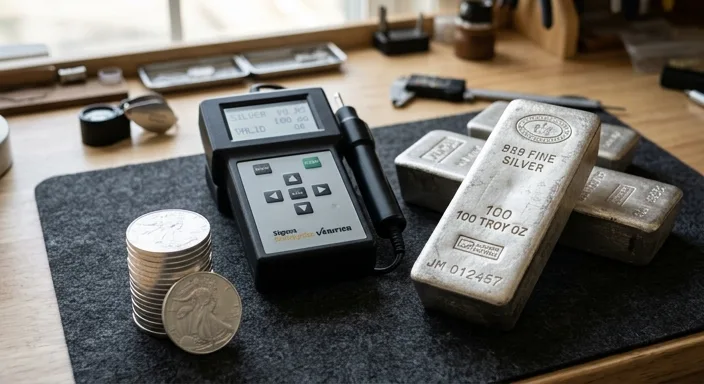
- Sigma Metalytics (PMV): The gold standard for private investors. Using electromagnetic waves, it "reads" through the metal to ensure the core matches the surface. It can verify metal even through plastic capsules or slabs.
- X-Ray Fluorescence (XRF): XRF scanners provide a chemical breakdown of the surface metal. While highly accurate for the surface, serious investors should be aware that XRF cannot see through thick plating into the core of a 100-ounce bar.
- Ultrasonic Testing: This is often used for 1,000-ounce COMEX-deliverable bars. It measures the speed of sound through the metal to detect internal voids or inserts of different density metals like tungsten.
Navigating Professional Certification Services
Verification confirms it is silver; certification confirms its grade and provenance. For bulk lots of coins (like Silver Eagles or Libertads), sending them to a third-party grading service (TPG) can significantly increase the premium.
The two industry leaders are PCGS (Professional Coin Grading Service) and NGC (Numismatic Guaranty Company). For bulk silver investors, the "Bulk Submission" program is vital. These programs offer lower per-coin costs for submissions of 100+ items of the same type. This is particularly effective for "First Strike" or "Early Release" labels which command higher resale values in the secondary market.
Managing the Bulk Authentication Workflow
When you receive a shipment of 500+ ounces, the process can be overwhelming. Follow this institutional-grade workflow:
- Receipt and Video: Always film the unboxing of bulk lots to document the state of the seals and the quantity received.
- The 10% Random Audit: If the lot is from a highly reputable mint (e.g., US Mint Monster Box), perform a random audit of 10% of the contents using a Sigma PMV.
- Secondary Sorting: Separate items that show milk spots, tarnish, or damage. These will be kept as "raw" bullion, while pristine specimens are set aside for potential grading.
- Logging: Maintain a digital spreadsheet with the weights, serial numbers (if applicable), and test results for every unit.
Maximizing Liquidity via Documentation
The goal of verification is not just safety—it's future liquidity. When you eventually sell a 5,000-ounce position, the buyer (whether a dealer or private party) will look for a "Chain of Custody."
Keep your original purchase invoices from reputable dealers alongside your verification logs. If you have utilized NDT, include the test dates and equipment used in your records. Certified "slabs" from NGC or PCGS provide the ultimate liquidity, as they are instantly recognizable and tradable worldwide without further testing required by the buyer.
Frequently Asked Questions
Generally, no. Large bars are treated as "melt" bullion. Certification via TPGs is for coins. For large bars, professional verification (Sigma/XRF) and keeping the original Assay certificate is sufficient.
A basic Sigma Metalytics PMV unit typically starts around $900-$1,200. For an investor with a $50,000+ silver position, this is a negligible 2% insurance cost for the lifetime of their investing career.
In bulk markets, some counterfeiters drill holes into thick silver bars, fill them with tungsten, and then plug the holes with silver. Ultrasonic testing is the most effective way to catch this without cutting the bar open.