I may earn a commission at no extra cost to you. #ad
The Investor’s Guide to Appraising Physical Silver Assets for Secondary Market Sales
Jump to Section
- 1. Understanding Silver Purity and Hallmarks
- 2. Weight Verification: The Troy Ounce Standard
- 3. Assessing Physical Condition and Eye Appeal
- 4. Distinguishing Bullion Value from Numismatic Value
- 5. Essential Appraisal Tools for Private Investors
- 6. Market Timing and Secondary Market Fluctuations
- Frequently Asked Questions
1. Understanding Silver Purity and Hallmarks
The foundation of any silver appraisal begins with verifying the metal's purity. In the secondary market, silver is typically traded based on its fine silver content. Most investment-grade silver is .999 fine, meaning it is 99.9% pure silver. However, investors often encounter various grades that significantly impact the appraisal value.
Common purity levels include:
- .999 / .9999: Investment-grade bullion (coins, rounds, and bars).
- .925 (Sterling): Common in flatware and jewelry; contains 92.5% silver and 7.5% copper.
- .900 (Junk Silver): Pre-1965 U.S. coinage (dimes, quarters, halves) which contain 90% silver.
- .800 / .500: Often found in European or Canadian vintage coinage.
Always look for hallmarks—stamps that indicate the manufacturer and purity. For secondary market sales, recognized hallmarks like Johnson Matthey, Engelhard, or Government Mints (US Mint, Royal Canadian Mint) command higher trust and faster liquidity than generic or "no-name" mints.
2. Weight Verification: The Troy Ounce Standard
A critical mistake made by novice investors is confusing the standard (Avoirdupois) ounce with the Troy ounce. In the precious metals world, all pricing is based on the Troy ounce, which is approximately 31.1035 grams. A standard ounce is only 28.35 grams. If your appraisal uses the wrong unit of measurement, you could be underestimating your asset's value by nearly 10%.
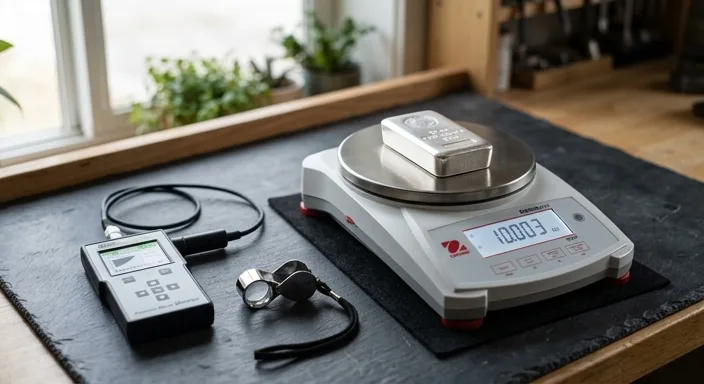
When appraising bulk lots for the secondary market, it is essential to weigh items individually or in verified groups. For "junk silver," investors often calculate the "melt value" by multiplying the total face value of the coins by the silver content per dollar (approximately 0.715 Troy ounces per $1 face value for circulated coins).
3. Assessing Physical Condition and Eye Appeal
While bullion is primarily valued for its metal content, the physical condition still plays a role in secondary market pricing. For modern bullion coins like Silver Eagles or Maples, "milk spots" (white cloudy patches) or significant tarnish can sometimes lead to a slightly lower premium, though the melt value remains unchanged.
Key factors to look for include:
- Rim Dings: Deep indentations on the edge of a coin or bar can suggest a loss of metal mass.
- Toning: Natural oxidation can result in colorful "rainbow" toning. In the numismatic world, this can increase value, but for standard bullion, it is often neutral or slightly negative.
- Scratches and Cleaning: Never clean your silver. Abrasive cleaning leaves "hairlines" that drastically reduce the value of coins with any numismatic potential.
4. Distinguishing Bullion Value from Numismatic Value
Before listing an asset on the secondary market, you must determine if it is "bullion" or "numismatic." Bullion follows the spot price of silver plus a small market premium. Numismatic items are valued based on rarity, historical significance, and professional grading (e.g., NGC or PCGS).
If you have a coin that appears to be in "Mint State" or is a low-mintage year, it may be worth more than its weight in silver. Investors should consult a "Red Book" or recent auction results for specific coin dates before selling them at melt value. Selling a rare date coin as generic bullion is a common and expensive mistake in secondary market transactions.
5. Essential Appraisal Tools for Private Investors
To accurately appraise your silver without paying a professional fee every time, you should invest in a few basic tools:
- Digital Scale: Must be able to measure in grams and Troy ounces with at least 0.01g accuracy.
- Calipers: Used to measure the diameter and thickness of coins to ensure they match official mint specifications (counterfeits are often thicker to compensate for lighter base metals).
- Rare Earth Magnet (Neodymium): Silver is diamagnetic. A magnet should not stick to it, and a "magnet slide test" should show a slow, resisted descent.
- Jeweler’s Loupe (10x): Essential for inspecting hallmarks and checking for surface authenticity.
6. Market Timing and Secondary Market Fluctuations
Secondary market prices are not static. They are influenced by the "Spot Price" (the current paper trading price of silver) and the "Physical Premium" (the extra cost driven by supply and demand for physical metal). During times of high economic uncertainty, premiums on the secondary market can skyrocket even if the spot price remains stable.
When appraising your assets for sale, check current "Buy Back" prices from major online dealers. This represents the "floor" of your appraisal. Private party sales (P2P) typically occur at a midpoint between the dealer buy-back price and the dealer retail price.
Frequently Asked Questions
Does tarnish reduce the value of my silver bars?
For standard bullion bars, tarnish (oxidation) generally does not reduce the value, as the silver content remains the same. However, for highly collectible bars, original luster is preferred.
How do I know if my silver coin is a counterfeit?
The most effective home tests are the "Ping Test" (silver has a specific high-pitched ring), weight verification, and dimensions check. For high-value items, use a Sigma Metalytics Verifier.
Is it worth getting my silver coins professionally graded?
Only if the coin has significant numismatic potential. Most bullion coins (Eagles, Maples) are not worth grading unless they are perfect "70" grades or rare early years.