I may earn a commission at no extra cost to you. #ad
Logistics and Insurance: A Free Guide to Moving Bulk Silver Assets Safely
Jump to Section
Moving a significant volume of silver—whether it’s several hundred ounces of Silver Eagles or 1,000-ounce industrial bars—presents a unique set of logistical challenges. Unlike gold, which packs immense value into a small, light footprint, silver is heavy, bulky, and prone to "clinking," which can give away its presence to prying ears. For the private investor or estate manager, ensuring the safe transit of these assets requires a blend of physical security, operational discretion, and robust insurance coverage.
The Physical Reality: Structural Integrity and Weight
The first rule of moving bulk silver is respecting the weight. A standard "monster box" of 500 American Silver Eagles weighs approximately 40 pounds. If you are moving a 10,000-ounce portfolio, you are dealing with over 680 pounds of dead weight. Standard cardboard boxes are not designed for this density.
When preparing for transport, you must use heavy-duty, double-walled boxes or high-impact plastic cases. If you are shipping via a common carrier, never exceed 50-60 pounds per individual parcel. Heavier packages are more likely to be dropped, causing the box to burst at the seams, exposing the contents to anyone in the sorting facility.
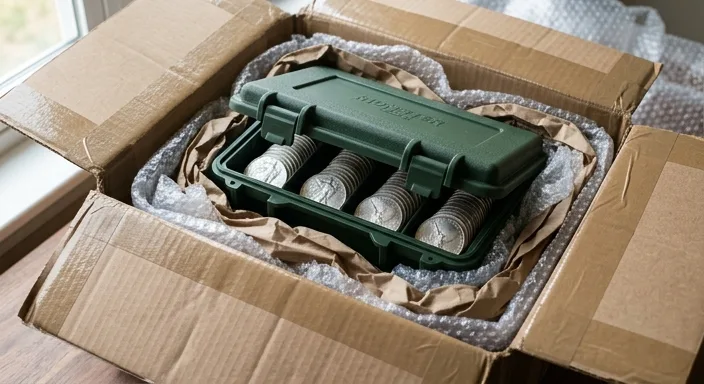
Stealth Packing Protocols for Large Shipments
Discretion is your greatest security feature. Your goal is to make a shipment of silver look and sound like a box of heavy hardware or machinery parts. Follow these three cardinal rules of stealth packing:
- Double-Boxing: Place your silver inside a primary box, seal it completely with fiber-reinforced tape, and then place that box inside a secondary, larger box. Fill the gaps with dense padding to prevent the inner box from shifting.
- Acoustic Dampening: Silver coins and bars clink. This sound is a "tell" for thieves. Use vacuum-sealing or tight plastic wrapping to ensure no two pieces of metal can touch or move against each other.
- Labeling Discretion: Never use words like "Silver," "Coins," "Bullion," or "Valuable" on the exterior label. If shipping to a dealer like "ABC Gold and Silver," address it to "ABC LLC" or use a person's name to avoid identifying the contents.
Carrier Selection: USPS vs. Private Couriers
For shipments within the United States, USPS Registered Mail is often considered the gold standard for high-value assets. Unlike "Certified" or "Express" mail, Registered Mail is kept in a locked cage and requires a signature at every point of transfer. The chain of custody is meticulously documented.
Private carriers like FedEx and UPS have strict limits on "prohibited items." Frequently, their standard insurance will not cover bullion or currency, or it is capped at a very low amount (often $500 or $1,000). If you use these services for bulk silver, you must ensure you have a third-party insurance policy that specifically overrides the carrier’s exclusions.
Insurance Strategies: Closing the Liability Gap
Do not rely on a standard homeowner's policy to cover silver while in transit; most policies explicitly exclude "property in the care of a common carrier." You have two primary options for insurance:
- Carrier-Provided Insurance: USPS Registered Mail allows for insurance up to $50,000 per package. While reliable, the claims process can be slow and requires exhaustive proof of value.
- Third-Party Transit Insurance: Companies like Shipsurance or specialized collectibles insurers offer policies for high-value movements. These are often cheaper than carrier insurance and provide better customer service during a claim.
Always document your shipment before sealing the box. Take a high-quality video of the items being packed, the box being sealed, and the final weight on a scale. This "proof of life" is essential for insurance claims.
When to Use Armored Transport Services
If your silver assets exceed $100,000 in value or weigh more than a few hundred pounds, it is time to move beyond the post office and into the world of armored transport. Companies like Brink's, Loomis, or Malca-Amit specialize in "Valuable Cargo" logistics.
These services offer door-to-door security, full liability coverage, and professional handling. While the cost is higher than shipping via USPS, the peace of mind—and the elimination of the physical labor of lugging heavy boxes to a post office—is often worth the investment for large-scale portfolio liquidations or transfers.
Frequently Asked Questions
Q: Is it safe to ship 500 oz of silver through the mail?
A: Yes, provided you use USPS Registered Mail and double-box the items. Registered mail is the most secure method for individual parcels up to $50,000 in value.
Q: Can I use FedEx to ship silver bars?
A: Technically yes, but FedEx's internal insurance rarely covers bullion. You must have an independent third-party insurance policy in place before shipping high-value silver via FedEx or UPS.
Q: How do I prove the value of my silver for an insurance claim?
A: Keep original purchase invoices and take a video or photos of the specific coins or bars being packed into the shipping container with a date stamp.
Q: Does my homeowners insurance cover my silver while I'm driving it to a buyer?
A: Usually no. Most standard policies have a "off-premises" limit for precious metals that is very low (often $200-$1,000). Check with your agent about a "scheduled personal property" rider.