I may earn a commission at no extra cost to you. #ad
The Ultimate Guide to Tax Strategies for High-Value Physical Silver Divestment
Jump to Section
The Collectibles Classification: IRS Section 1(h)
When dealing with high-value silver divestment, the most critical realization is that the IRS does not treat physical silver—whether in the form of bullion bars, American Silver Eagles, or junk silver lots—the same as stocks or bonds. Under Internal Revenue Code Section 1(h), physical precious metals are classified as "collectibles."
This classification is significant because it subjects long-term capital gains to a maximum tax rate of 28%. This is notably higher than the 15% or 20% rates typically applied to long-term gains on traditional securities. For high-net-worth individuals divesting bulk silver, failing to account for this 8-13% gap can result in a substantial unexpected tax liability.
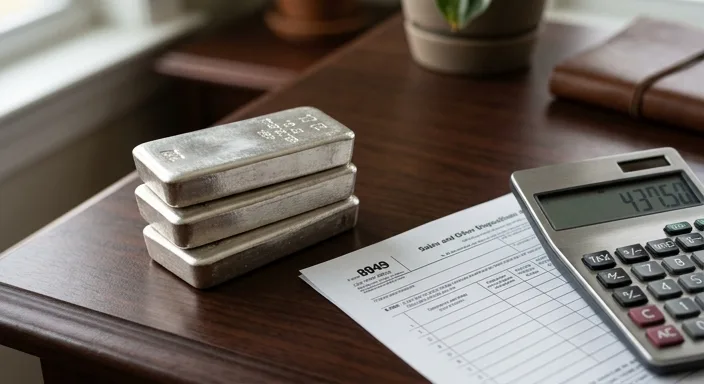
Short-Term vs. Long-Term Capital Gains
The duration of your silver holding dictates the tax methodology used. For high-value lots, the distinction is binary:
- Short-Term Capital Gains: If you hold your silver for one year or less, the profit is taxed as ordinary income. Depending on your tax bracket, this could reach as high as 37%.
- Long-Term Capital Gains: If held for more than 365 days, the gain is taxed at the "collectibles" rate, capped at 28%. However, if your ordinary income tax bracket is lower than 28%, you will pay that lower rate.
Investors must also factor in the Net Investment Income Tax (NIIT) of 3.8%, which may apply to silver sales if your modified adjusted gross income (MAGI) exceeds specific thresholds ($250,000 for married filing jointly).
The Precision of Cost-Basis Calculation
For large silver coin lots acquired over decades, determining the cost basis—the original price paid plus commissions and storage fees—can be a logistical nightmare. However, precision here is your best defense against over-taxation.
If you inherited the silver, you generally receive a "step-up" in basis to the fair market value on the date of the original owner's death. If you purchased the silver in multiple increments, you may use the Specific Identification Method. This allows you to "sell" the lots with the highest cost basis first, thereby minimizing the taxable gain. If records are unavailable, the IRS defaults to FIFO (First-In, First-Out), which often results in the largest possible taxable gain during periods of silver price appreciation.
Strategic Offsetting and Tax-Loss Harvesting
One of the most effective strategies for high-value divestment is Tax-Loss Harvesting. If you are liquidating a silver lot at a significant profit, you can offset those gains by selling other underperforming assets (like stocks, real estate, or even other metals like platinum) at a loss.
It is important to note that while the "Wash Sale Rule" currently applies to "stocks and securities," the application to physical commodities is a gray area in tax law. However, most conservative tax professionals recommend waiting 30 days before re-purchasing a similar silver asset if you have claimed a loss, to avoid the transaction being labeled a "sham" by the IRS.
Reporting Thresholds and Form 1099-B
Confusion often surrounds what a dealer is required to report versus what an individual is required to report. Dealers are required to file Form 1099-B only when specific quantities of specific silver products are sold. For example, the sale of 1,000 troy ounces of silver bars (999 fine) or certain pre-1964 silver coin bags may trigger a dealer report.
Crucial Distinction: Even if your sale does not trigger a dealer's 1099-B reporting requirement, you are legally obligated to report the gain on your personal tax return (Form 8949 and Schedule D). Privacy in the transaction does not equate to tax exemption.
Advanced Vehicles: Trusts and Charitable Giving
For those divesting extremely large positions (six to seven figures), advanced estate planning tools can be utilized:
- Charitable Remainder Trusts (CRT): You can donate silver to a CRT, sell it tax-free within the trust, and receive an income stream for life, effectively deferring and reducing the tax burden.
- Donor-Advised Funds (DAF): Donating appreciated silver directly to a DAF allows you to claim a fair market value deduction (up to 30% of AGI) and avoid the 28% collectibles tax entirely.
Frequently Asked Questions
1. Is American Silver Eagle bullion taxed differently than silver bars?
No. For federal tax purposes, both are considered collectibles and are subject to the same capital gains rules.
2. Can I use a 1031 Exchange for physical silver?
No. The Tax Cuts and Jobs Act of 2017 eliminated 1031 "like-kind" exchanges for personal property, including precious metals. Only real estate now qualifies.
3. What happens if I can't prove my original purchase price?
If you lack receipts or documentation, the IRS may assign a cost basis of zero, meaning you will be taxed on the full sale price. It is vital to find contemporary price charts from the year of acquisition if receipts are lost.